• Request Info
  • Visit
  • Apply
  • Give
  • Request Info
  • Visit
  • Apply
  • Give

Search

A-Z Index Map

Chemistry

  • About
    • Student Organizations
    • Connect With Us
    • Careers With Us
    • Employee/Student Travel Request
    • Newsletters
  • Undergraduate Students
    • Majors and Minors
    • First Year Students
    • Undergraduate Research
    • Chemistry Learning Centers
    • Chemistry Lab Excused Absence
    • Apply
  • Graduate Students
    • Prospective Students
    • Admitted Students
    • Current Students
    • Graduate Program Virtual Office Hours
    • Chemistry Graduate Student Handbook
  • Faculty
  • People
  • Research
    • Research Areas
    • Facilities
  • News
  • New Chemistry Building
Home » Archives for September 2026

September 2026

Archives for September 2026

Joseph Clark.

Scholar Spotlight: Joseph Clark

September 30, 2026 by Kaitlin Coyle

Joseph Clark.

“I am an organic chemist working with molecules that can make medicines safer. I design and oversee the synthesis of compounds by utilizing molecules, reagents, solvents, specialized equipment, and other tools.”

Joseph Clark
Associate Professor
Department of Chemistry

My research group designs new chemical reactions for incorporating deuterium, the naturally occurring isotope of hydrogen, into small molecules and compounds in a highly selective manner. With precise installation, we can construct deuterated molecules for specific applications such as modulating drug metabolism or enhancing drug half-life. These efforts may lead to the discovery of safer and more effective medicines.

Many isotopically chiral molecules have been nearly impossible to analyze for determining properties such as enantiomeric enrichment and assignment of absolute configuration. Not only has my research group made these interesting molecular entities, but we have provided the first-ever solution to this nearly century-old problem of characterizing them.  

Why I do what I do

I always enjoyed working with my hands and solving challenging problems. Chemistry allows me to do both at a high level while also having a positive impact on people’s lives. There is always a more challenging problem to solve, and it is a great privilege to have a research lab where I can test new hypotheses where a positive result can lead to paradigm-shifting research. The excitement and thrill from this process inspired me to pursue a chemistry career. 

With my PhD and postdoctoral training, I saw an opportunity to impact a new and rapidly emerging field. In 2017, the Food and Drug Administration approved the first deuterated drug molecule (Deutetrabenazine), and I built my current research program around designing new chemical reactions to expand chemical access to more deuterated drugs.

Currently working on

My research lab is now developing new chemical reactions for incorporating tritium into small molecules. Tritium is the radioactive isotope of hydrogen and is routinely used in drug discovery applications such as acquiring early safety and toxicity data for new drug candidates. We are looking to expand access to the type of drug molecules that can be labeled with tritium to expand the applications of this important isotope.

Filed Under: Featured, News

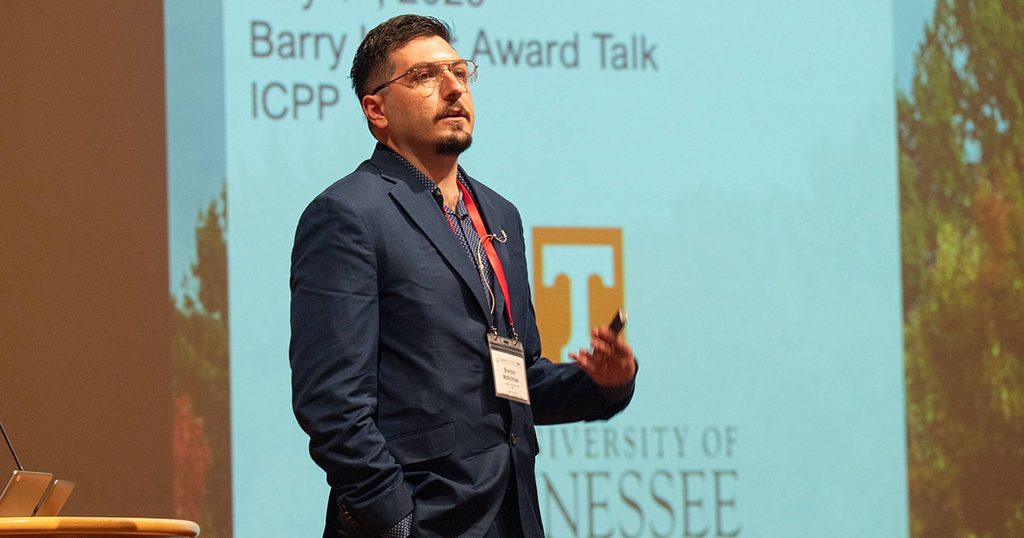
Dr. Brendon McNicholas delivers the inaugural Barry Lever Young Investigator Award talk in Kyoto, Japan.

McNicholas Receives Barry Lever Award for Young Investigators

September 11, 2026 by Jennifer Brown

Dr. Brendon McNicholas stands in front of a large screen delivering the Barry Lever Young Investigator Award talk. He wears a navy blue suit and is looking out toward the audience.

Assistant Professor of Chemistry Brendon McNicholas recently received the inaugural Barry Lever Award for Young Investigators. The award was presented at this year’s 14th International Conference on Porphyrins and Phthalocyanines (ICPP) and was created to recognize early-career researchers working in the field of physical inorganic chemistry.

McNicholas joined the University of Tennessee, Knoxville in 2023 after completing his PhD and postdoctoral work at the California Institute of Technology. His research group conducts physical inorganic and materials chemistry research, focusing on fundamental understanding of the electronic structure of Prussian blue analogs, phthalocyanines and other porphyrinoid macrocycles, and their frameworks for applications in energy storage and conversion. McNicholas’s team is particularly interested in the application of these materials in sodium ion battery technology.

“We’re investigating sodium-ion batteries in the interest of identifying alternatives to lithium ion batteries,” said McNicholas. “When you compare the natural abundance of lithium to sodium, sodium is far more abundant. As we continue to consume lithium in our electronic devices, future scarcity could become a problem. Identifying alternative batteries with comparable energy densities is a potential way to address this.”

As the winner of the Barry Lever Young Investigator award, McNicholas was invited to speak at the ICPP, held in Kyoto, Japan in July. His talk, entitled “Phthalocyanines as Multifunctional Platforms: Fundamental Electronic Structure, Energy Storage, and Electrocatalytic Applications,” discussed the fundamental electronic structure of main-group and paramagnetic phthalocyanines, their redox properties, and how these properties can be leveraged in energy storage and electrocatalytic applications.

“I’m truly honored and grateful to have been selected for this award,” said McNicholas. “It means a lot to me to receive an award in the name of someone so influential in the field of phthalocyanine chemistry.”

McNicholas says the overarching aim of his lab’s research is to contribute to the pursuit of a net-zero carbon economy, where new greenhouse gas emissions are balanced by equal or greater removal. This ethos is threaded through his energy storage work, as well as his investigation into developing more efficient electrocatalysts for small molecule reduction and oxidation.

“In our electrocatalysis work, one of the things we’re trying to do is find a way to make value-added products from things that are traditionally seen as greenhouse gases. An example of this is converting CO2 into hydrocarbons and alcohols under flow electrolysis conditions and discovering new catalysts for milder epoxidation of olefin substrates,” said McNicholas.

In 2026, McNicholas has co-authored three publications, published in The Journal of Physical Chemistry Letters, Inorganic Chemistry, and The Journal of Physical Chemistry A. The Barry Lever Award for Young Investigators includes invited publication in The Journal of Porphyrins and Phthalocyanines, expected to be published in October.

Filed Under: Inorganic Chemistry, News Tagged With: Barry Lever, electrocatalysis, McNicholas, porphyrins, sodium ion batteries

Chemistry

College of Arts & Sciences

552 Buehler Hall
1420 Circle Dr.
Knoxville, TN 37996-1600

Email: chemistry@utk.edu

Phone: 865-974-3141

Facebook Icon  X Icon  Instagram Icon  YouTube Icon LinkedIn Icon

The University of Tennessee, Knoxville
Knoxville, Tennessee 37996
865-974-1000

The flagship campus of the University of Tennessee System and partner in the Tennessee Transfer Pathway.

ADA Privacy Safety Title IX