
McNicholas Receives Barry Lever Award for Young Investigators
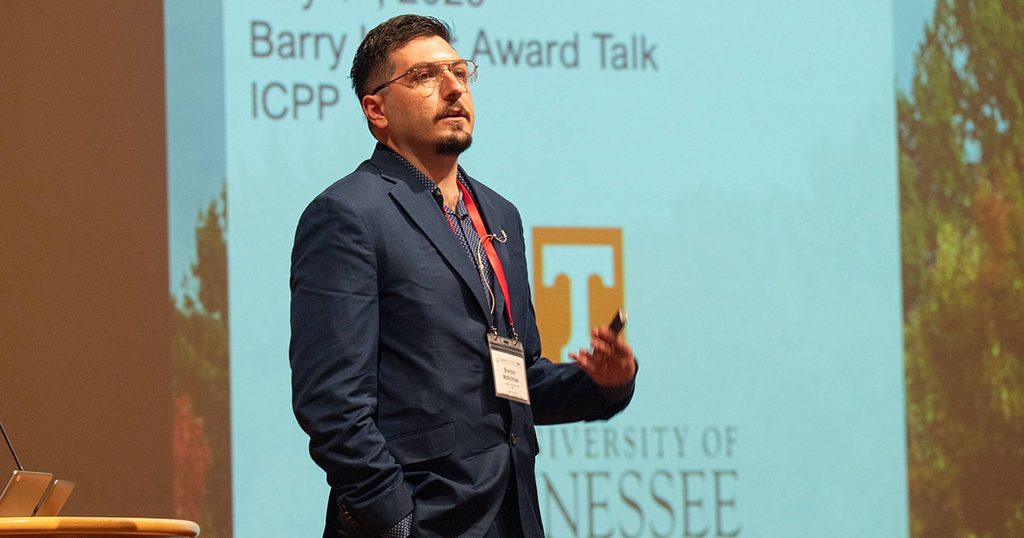
Assistant Professor of Chemistry Brendon McNicholas recently received the inaugural Barry Lever Award for Young Investigators. The award was presented at this year’s 14th International Conference on Porphyrins and Phthalocyanines (ICPP) and was created to recognize early-career researchers working in the field of physical inorganic chemistry.
McNicholas joined the University of Tennessee, Knoxville in 2023 after completing his PhD and postdoctoral work at the California Institute of Technology. His research group conducts physical inorganic and materials chemistry research, focusing on fundamental understanding of the electronic structure of Prussian blue analogs, phthalocyanines and other porphyrinoid macrocycles, and their frameworks for applications in energy storage and conversion. McNicholas’s team is particularly interested in the application of these materials in sodium ion battery technology.
“We’re investigating sodium-ion batteries in the interest of identifying alternatives to lithium ion batteries,” said McNicholas. “When you compare the natural abundance of lithium to sodium, sodium is far more abundant. As we continue to consume lithium in our electronic devices, future scarcity could become a problem. Identifying alternative batteries with comparable energy densities is a potential way to address this.”
As the winner of the Barry Lever Young Investigator award, McNicholas was invited to speak at the ICPP, held in Kyoto, Japan in July. His talk, entitled “Phthalocyanines as Multifunctional Platforms: Fundamental Electronic Structure, Energy Storage, and Electrocatalytic Applications,” discussed the fundamental electronic structure of main-group and paramagnetic phthalocyanines, their redox properties, and how these properties can be leveraged in energy storage and electrocatalytic applications.
“I’m truly honored and grateful to have been selected for this award,” said McNicholas. “It means a lot to me to receive an award in the name of someone so influential in the field of phthalocyanine chemistry.”
McNicholas says the overarching aim of his lab’s research is to contribute to the pursuit of a net-zero carbon economy, where new greenhouse gas emissions are balanced by equal or greater removal. This ethos is threaded through his energy storage work, as well as his investigation into developing more efficient electrocatalysts for small molecule reduction and oxidation.
“In our electrocatalysis work, one of the things we’re trying to do is find a way to make value-added products from things that are traditionally seen as greenhouse gases. An example of this is converting CO2 into hydrocarbons and alcohols under flow electrolysis conditions and discovering new catalysts for milder epoxidation of olefin substrates,” said McNicholas.
In 2026, McNicholas has co-authored three publications, published in The Journal of Physical Chemistry Letters, Inorganic Chemistry, and The Journal of Physical Chemistry A. The Barry Lever Award for Young Investigators includes invited publication in The Journal of Porphyrins and Phthalocyanines, expected to be published in October.