• Request Info
  • Visit
  • Apply
  • Give
  • Request Info
  • Visit
  • Apply
  • Give

Search

A-Z Index Map

Chemistry

  • About
    • Student Organizations
    • Connect With Us
    • Careers With Us
    • Employee/Student Travel Request
    • Newsletters
  • Undergraduate Students
    • Majors and Minors
    • First Year Students
    • Undergraduate Research
    • Summer Programs
    • Chemistry Lab Excused Absence
    • Apply
  • Graduate Students
    • Prospective Students
    • Admitted Students
    • Current Students
    • Research Open House
    • Chemistry Graduate Student Handbook
  • Faculty
  • People
  • Research
    • Research Areas
    • Facilities
  • News
  • New Chemistry Building
Home » Inorganic Chemistry

Inorganic Chemistry

Professor David Jenkins

Jenkins Publication Investigates Metal-Organic Nanotube Interactions

April 24, 2026 by Jennifer Brown

Professor David Jenkins

Chemistry professor David Jenkins along with his graduate student Jacob Barrett and postdoc Phattananawee Nalaoh recently published an article in the Journal of the American Chemical Society (JACS). The article, entitled “Intertube Interactions in Multivariant Metal-Organic Nanotubes” highlights Jenkins’s exploration of the fundamental understanding of metal-organic nanotubes (MONTs). MONTs are a relatively new 1D subclass of metal-organic frameworks (MOFs).

In 2025, the Nobel prize in chemistry was awarded to three researchers working on MOFs.  MOFs are materials composed of metal ions linked together by organic molecules. The manipulation of these linkages can create materials for a variety of applications, including gas storage, chemical separations, and catalysis.

“The easiest way to think about a metal organic framework is to think about a cube that is infinite in all directions,” said Jenkins.  “Each vertex of the cube, each point, is a metal containing piece, and each edge on the cube is an organic group that connects the vertices. On the inside is a hole, which makes it porous, but these pores are on the nanometer scale.”

MONTs, the subject of Jenkins’s research, are a subclass on MOFs. However, instead of a cube, MONTs are tube-shaped structures, similar to straws. MONTs come together in small bundles, and the interactions between individual MONTs in those bundles have a greater impact on the MONTs’ properties.

“If you imagine a group of straws, they’re typically held together by the box or container they’re in. MONTs have very, very weak chemical interactions holding them together between the straws because there is no box on the outside. These are weaker forces than a classic chemical bond,” said Jenkins.  “In this paper, we looked at how different types of forces could be applied with different organic linkers on the tube, and how that would change the shape and interaction between them.”

PhD student Jacob Barrett is a member of the Jenkins research group.

Though MONTs are a fairly new material in comparison to MOFs, the Jenkins group has been investigating MONTs for over a decade. He and his team published one of the earliest large-scale papers on the synthesis of MONTs in 2014. Since then, they have continued developing the foundational knowledge necessary to discover potential future applications of MONTs. Their recent paper, co-authored by PhD student Jacob Barrett, provides another layer of understanding to that foundation.

“The small spaces in between matter a lot more for MONTs than they do for MOFs,” said Barrett.  “Understanding the interactions between MONTs is critical to understanding both how they will behave as a bulk material, and how we can tune their size and shape to achieve specific outcomes.”

This work was funded by the National Science Foundation (NSF). The full article can be read on the ACS Publications website.

Filed Under: Inorganic Chemistry, News Tagged With: Jenkins, MOF

Sheng Dai Among World’s Most Highly Cited Researchers for 10 Years

December 4, 2025 by Jennifer Brown

Sheng Dai, professor of chemistry, is one of six faculty members from the University of Tennessee, Knoxville to be named to Clarivate’s Highly Cited Researchers list for 2025, an honor bestowed on only one in 1,000 of the world’s scientists and social scientists. The designation recognizes researchers whose publications are among the top 1% by citations in their respective fields over the past decade.

“Being named among the world’s most highly cited researchers is a powerful testament to the global impact of our faculty and students’ work,” said Deb Crawford, UT’s vice chancellor for research, innovation, and economic development. “We are incredibly proud of these scholars, whose research continues to shape their disciplines and strengthen UT’s reputation as a leader in research that impacts the world.”

Dai, who holds a joint faculty appointment at Oak Ridge National Laboratory, has been named to the Highly Cited Researchers list for the 10th time. His work focuses on developing advanced materials for energy-related applications, particularly in areas like ionic liquids and molten salts, advanced separation processes, high-entropy materials, electrochemical processes and sustainable carbon transformations.

Dai is currently studying ionic liquids and porous materials to learn how they can be used for separating different substances, storing energy and speeding up chemical reactions. He is also developing ways to turn plant-based carbon into graphite, which can be used for storing energy.

Filed Under: Inorganic Chemistry, News, newsletter Tagged With: Clarivite, Sheng Dai

headshot

Xue Group Publishes in Nature Communications

November 17, 2023 by Jennifer Brown

The Xue Research Group has published their recent work in the journal Nature Communications. The Xue Group is helmed by Professor Ziling (Ben) Xue, whose work includes materials chemistry and the study of magnetism.

Xue’s paper, “Haldane topological spin-1 chains in a planar metal-organic framework” describes his group’s work exploring the magnetic properties of NiBO. NiBO was previously reported as part of a family of two-dimensional metal coordination polymers, also known as MOFs (Metal-Organic Frameworks) but the possible topological magnetic properties of the material had not been investigated.

Xue’s team used a variety of techniques to examine the material, including variable-temperature powder neutron diffraction, inelastic neutron scattering, and Monte Carlo simulations of the spin-1 chains found in NiBO. They began testing not knowing what NiBO would reveal but the results of their work showed the material fell into a particular category of magnetic materials known as Haldane topological solids.

Haldane topological materials possess a specific magnetic characteristic that makes them potentially useful in spintronics (or spin electronics) and quantum computing. Xue’s findings could be relevant to the development of next-generation storage materials and the future of medical detectors.

Xue’s team included recent PhD graduate Pagnareach Tin and current PhD student Michael Jenkins, whose work he described as critical to the success of the project. The team also collaborated with Jie Xing and Rongyin Jin at the University of South Carolina, Nils Caci and Stefan Wessel at RWTH Aachen University in Germany, J. Krzystek at National High Magnetic Field Laboratory, and Zheng Gai, Cheng Li, Luke Daemen, and Yongqiang Cheng at Oak Ridge National Laboratory.

Read the full article here.

Filed Under: Inorganic Chemistry, News Tagged With: inorganic, Xue

chemistry data visualized

Jenkins Lab Published in Angewandte Chemie

March 1, 2023 by Jennifer Brown

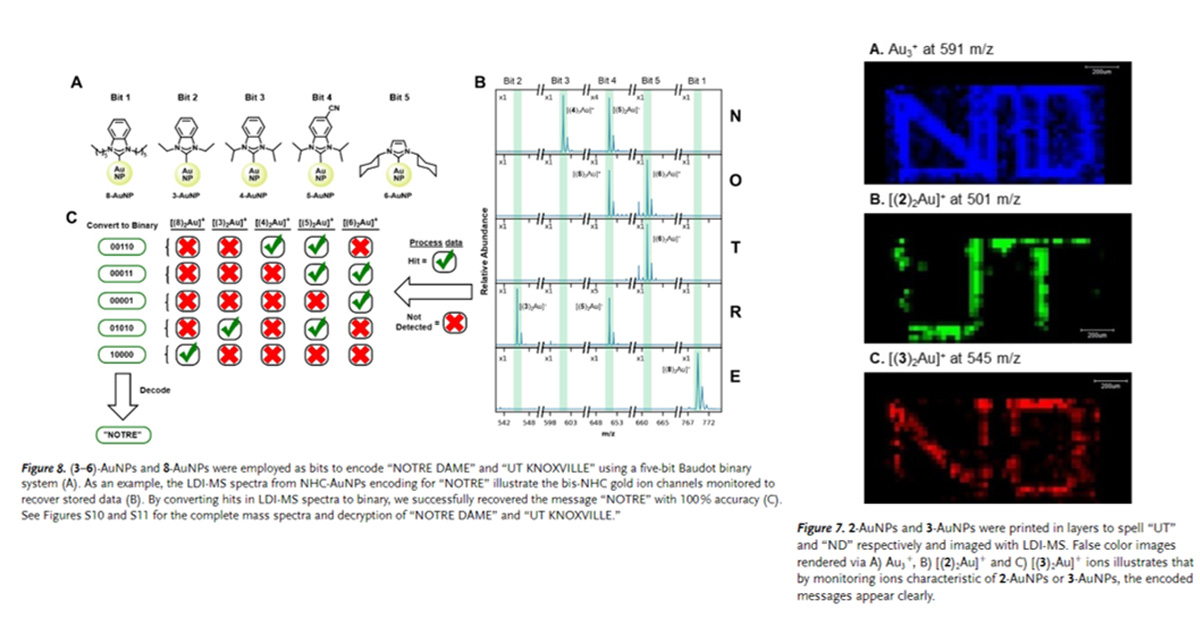
The Jenkins Lab published their research “Giving Gold Wings: Ultrabright and Fragmentation Free Mass Spectrometry Reporters for Barcoding, Bioconjugation Monitoring, and Data Storage” in the international journal Angewandte Chemie. Graduate students Isabel Jensen and Gurkiran Kaur were co-authors on the piece. 

The widespread application of laser desorption/ionization mass spectrometry (LDI-MS) highlights the need for a bright and multiplexable labeling platform. While ligand-capped Au nanoparticles (AuNPs) have emerged as a promising LDI-MS contrast agent, the predominant thiol ligands suffer from low ion yields and extensive fragmentation.

In this work, they developed a N-heterocyclic carbene (NHC) ligand platform that enhances AuNP LDI-MS performance. NHC scaffolds are tuned to generate barcoded AuNPs which, when benchmarked against thiol-AuNPs, are bright mass tags and form unfragmented ions in high yield. To illustrate the transformative potential of NHC ligands, the mass tags were employed in three orthogonal applications: monitoring a bioconjugation reaction, performing multiplexed imaging, and storing and reading encoded information.

These results demonstrate that NHC-nanoparticle systems are an ideal platform for LDI-MS and greatly broaden the scope of nanoparticle contrast agents.

Filed Under: Inorganic Chemistry, News Tagged With: inorganic, Jenkins

chemistry data visualized

Jenkins Group Published in Chemical Science

January 9, 2023 by Jennifer Brown

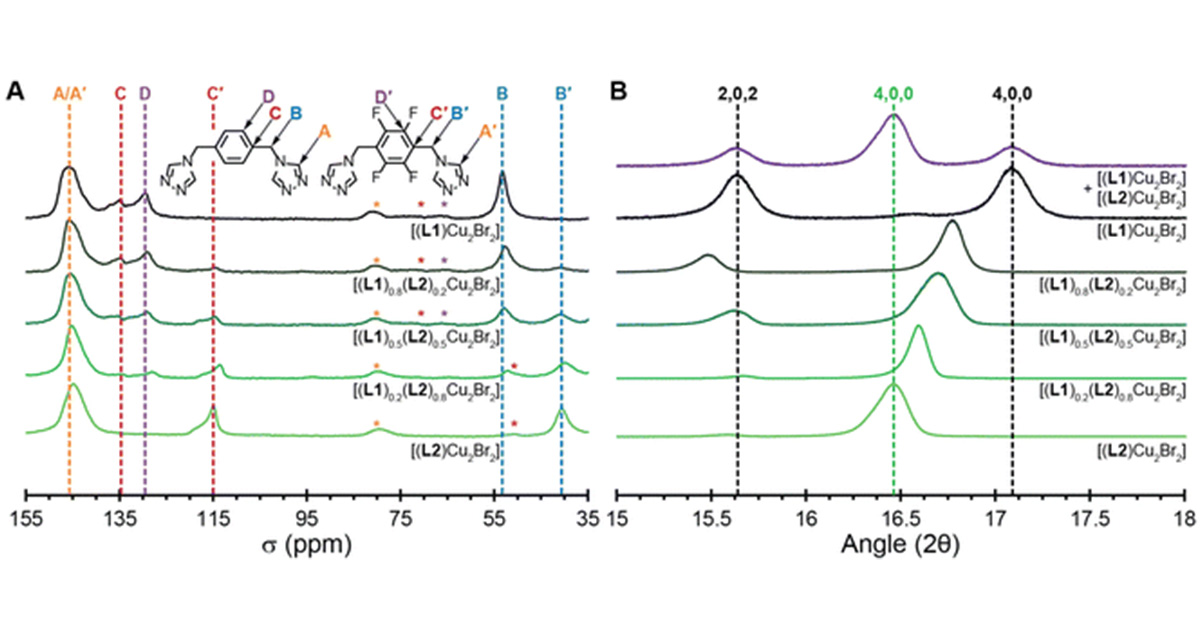
The Jenkins Lab published their research “Statistical copolymer metal organic nanotubes” in the journal Chemical Science. Graduate student Jacob Barrett co-authored the publication.

Metal–organic nanotubes (MONTs) are 1-dimensional crystalline porous materials that are formed from ligands and metals in a manner identical to more typical 3-dimensional metal–organic frameworks (MOFs). MONTs form anisotropically in one dimension making them excellent candidates for linker engineering for control of chemical composition and spacing.

A novel series of MONTs was synthesized utilizing a mixture of 1,2,4-ditriazole ligands containing both a fully protonated aryl moiety and its tetrafluorinated analog in ratios of, 0 : 1, 1 : 4, 1 : 1, 4 : 1, and 1 : 0, respectively. All MONTs were characterized by both bulk and nanoscale measurements, including SCXRD, PXRD, ssNMR and TEM, to determine the resulting co-polymer architecture (alternating, block, or statistical) and the ligand ratios in the solid materials.

All characterization methods point towards statistical copolymerization of the materials in a manner analogous to 3D MOFs, all of which notably could be achieved without destructive analytical methods.

Filed Under: Inorganic Chemistry, News Tagged With: inorganic, Jenkins

Recent Posts

  • Best Named Undergraduate Research Mentor of the Year
  • 2026 Honors Day
  • Banerjee Brings Machine Learning to Materials Science
  • Shaughnessy Opens a New Chapter in Chemistry at UT
  • 2026 Undergraduate Awards

Recent Comments

No comments to show.

College of Arts & Sciences

117 Natalie L. Haslam Music Center
1741 Volunteer Blvd.
Knoxville TN 37996-2600

Phone: 865-974-3241

Archives

  • May 2026
  • April 2026
  • March 2026
  • February 2026
  • December 2025
  • October 2025
  • September 2025
  • August 2025
  • July 2025
  • May 2025
  • April 2025
  • March 2025
  • December 2024
  • November 2024
  • October 2024
  • September 2024
  • August 2024
  • July 2024
  • June 2024
  • May 2024
  • April 2024
  • March 2024
  • February 2024
  • December 2023
  • November 2023
  • September 2023
  • July 2023
  • June 2023
  • May 2023
  • April 2023
  • March 2023
  • January 2023
  • December 2022
  • November 2022
  • July 2022
  • June 2022
  • May 2022
  • April 2022
  • March 2022
  • February 2022
  • January 2022
  • December 2021
  • November 2021
  • October 2021
  • July 2021
  • June 2021
  • May 2021
  • April 2021
  • March 2021
  • February 2021
  • January 2021
  • December 2020
  • November 2020
  • October 2020
  • September 2020
  • August 2020
  • July 2020
  • June 2020
  • May 2020
  • April 2020
  • March 2020
  • February 2020
  • January 2020
  • November 2019
  • October 2019
  • September 2019
  • August 2019
  • July 2019
  • May 2019
  • April 2019
  • March 2019
  • February 2019
  • September 2018
  • July 2018
  • June 2018
  • December 2017
  • October 2017
  • September 2017
  • August 2017
  • July 2017
  • June 2017
  • May 2017
  • April 2017
  • March 2017
  • January 2017
  • December 2016
  • November 2016
  • October 2016
  • September 2016
  • August 2016
  • June 2016
  • May 2016
  • April 2016
  • February 2016
  • January 2016
  • December 2015
  • November 2015
  • October 2015
  • August 2015
  • July 2015
  • June 2015
  • May 2015
  • April 2015
  • March 2015
  • February 2015
  • November 2014
  • October 2014
  • September 2014
  • August 2014
  • July 2014
  • June 2014
  • May 2014
  • April 2014
  • March 2014
  • February 2014
  • January 2014
  • December 2013
  • November 2013
  • October 2013
  • September 2013
  • August 2013
  • July 2013
  • June 2013
  • May 2013
  • April 2013
  • March 2013
  • February 2013
  • January 2013
  • September 2012
  • August 2012
  • July 2012
  • June 2012
  • May 2012
  • April 2012
  • February 2012
  • January 2012
  • December 2011
  • October 2011
  • August 2011
  • July 2011
  • June 2011
  • May 2011
  • April 2011
  • March 2011
  • January 2011
  • November 2010
  • October 2010
  • September 2010
  • August 2010
  • July 2010
  • June 2010

Categories

  • ACGS
  • alumni
  • Analytical Chemistry
  • Artsci
  • award
  • Bailey
  • Best
  • BOV
  • Brantley
  • Calhoun
  • Campagna
  • Dadmun
  • Dai
  • Darko
  • Do
  • endowment
  • faculty
  • Faculty
  • Featured
  • fellowship
  • Graduate Student Spotlight
  • Graduate Students
  • Hazari
  • Heberle
  • Inorganic Chemistry
  • Jenkins
  • Kilbey
  • Larese
  • Long
  • Musfeldt
  • NCW
  • Nemykin
  • News
  • newsletter
  • Organic Chemistry
  • outreach
  • Physical Chemistry
  • Polymer Chemistry
  • Sharma
  • Sokolov
  • Uncategorized
  • undergraduate
  • Undergraduate Student Spotlight
  • Vogiatzis
  • Xue
  • Zhao

Copyright © 2026 · University of Tennessee, Knoxville WDS Genesis Child on Genesis Framework · WordPress · Log in

Chemistry

College of Arts & Sciences

552 Buehler Hall
1420 Circle Dr.
Knoxville, TN 37996-1600

Email: chemistry@utk.edu

Phone: 865-974-3141

Facebook Icon  X Icon  Instagram Icon  YouTube Icon LinkedIn Icon

The University of Tennessee, Knoxville
Knoxville, Tennessee 37996
865-974-1000

The flagship campus of the University of Tennessee System and partner in the Tennessee Transfer Pathway.

ADA Privacy Safety Title IX