• Request Info
  • Visit
  • Apply
  • Give
  • Request Info
  • Visit
  • Apply
  • Give

Search

  • A-Z Index
  • Map

Chemistry

  • About
    • Student Organizations
    • Connect With Us
    • Careers With Us
    • Employee/Student Travel Request
  • Undergraduate Students
    • Majors and Minors
    • First Year Students
    • Undergraduate Research
    • Summer Programs
    • Chemistry Lab Excused Absence
    • Apply
  • Graduate Students
    • Prospective Students
    • Admitted Students
    • Current Students
    • Chemistry Graduate Student Handbook
  • Faculty
  • People
  • Research
    • Research Areas
    • Facilities
    • SMLQC 2025
  • News
  • New Chemistry Building
Home » Konstantinos Vogiatzis
Tag: Konstantinos Vogiatzis
Vogiatzis Featured Image

Vogiatzis Group Publishes in Journal of Physical Chemistry Letters

July 31, 2023 by Jennifer Brown

Grier Jones, fifth year chemistry PhD student, and Associate Professor Konstantinos Vogiatzis recently published a new data-driven quantum chemistry method, based on the reduced-density matrix (RDM) formulation of quantum mechanics, in the Journal of Physical Chemistry Letters. This publication was developed in collaboration with University of Tennessee, Knoxville alumnus Professor A. Eugene DePrince (’05) and his research group at Florida State University. DePrince’s group specializes in the development of novel RDM methods for the treatment of strongly correlated electrons.

Strong electron correlation lies at the heart of molecular quantum mechanics and, in particular, at the heart of electronic structure theory. Configuration interaction (CI) theory provides an exact description of strong correlation, but it suffers from exponential scaling with respect to the number of correlated electrons and orbitals. As an alternative, variational two-electron RDM (v2RDM) methods have been introduced since the energy of a many-electron system can be formulated exactly using the two-electron RDMs (2RDMs). One interesting property is that the 2RDM can be formulated without explicit knowledge of the wave function. In practice, finding a wave function that maps explicitly to the 2RDM can be very tricky, and the resulting deviation between CI- and RDM-based methods can be very large.

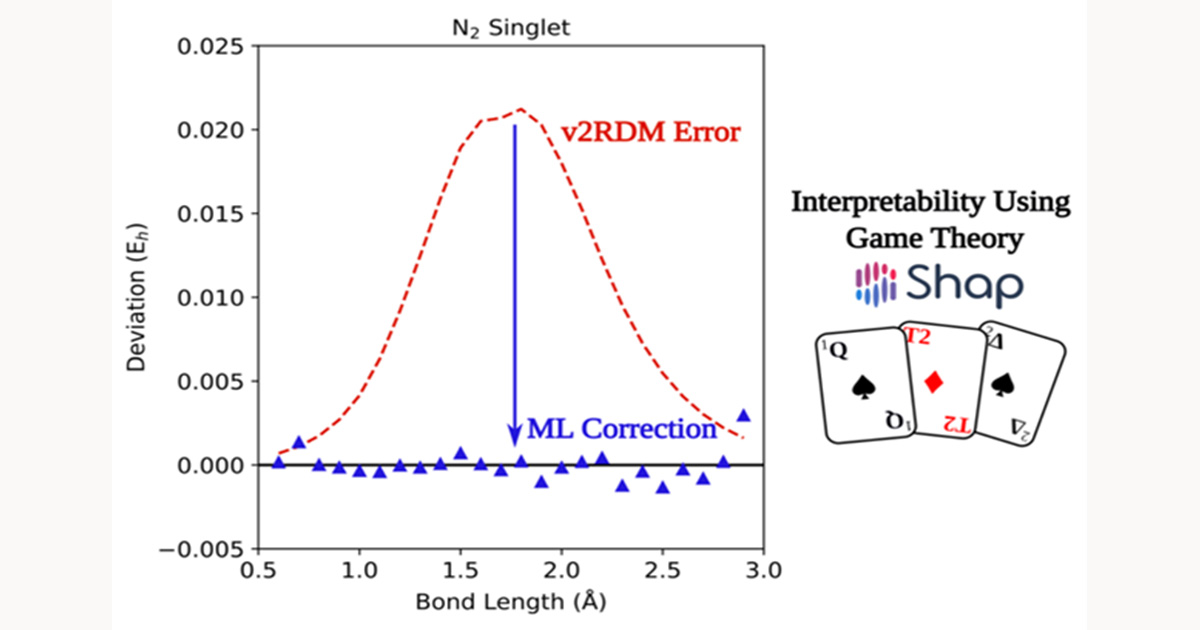
To resolve this issue, a collaboration between the Vogiatzis and DePrince groups lead to the development of the data-driven v2RDM (DDv2RDM) method to learn CI-quality energies using data generated using the v2RDM-complete active space self-consistent field (CASSCF) method. Using proof-of-principle calculations, they found that the model learns the correction the v2RDM energy near-chemical accuracy (1 kcal/mol). They also introduced the use of SHapley Additive exPlanation (SHAP) values, a feature importance method based on cooperative game theory, to analyze the how their physics-based features affect model performance. The SHAP analysis confirmed that the features that impact the model performance the most (and least) correspond well to insights based on physical principles.

Read the full article here.

Filed Under: News, Physical Chemistry, Vogiatzis Tagged With: Grier Jones, Konstantinos Vogiatzis, physical chemistry, quantum chemistry

Vogiatzis Group Publishes in npj Computational Materials

June 23, 2023 by Jennifer Brown

Associate Professor of Chemistry Konstantinos Vogiatzis, in collaboration with Professor of Mathematics Vasileios Maroulas and Eastman Chemical Company, has published a new machine learning model for predicting the properties of new polymeric materials.

Polymers are everywhere. From cookware to medical devices, polymers have become important to modern life due in part to a growing list of potential uses, and desirable properties like high durability and resistance to corrosion.

Creating new polymers can be an expensive, time-consuming process. Because of this, researchers attempt to predict the future properties of polymers using a variety of tools. Computational prediction methods allow researchers to screen polymer combinations for the desired properties before beginning experimentation. However, finding ways to represent polymers as machine-readable inputs can be difficult, creating a challenge for developing accurate prediction models.

Vogiatzis’ team is attempting to tackle these challenges by creating a deep learning method to predict polymer properties called PolymerGNN. PolymerGNN relies on state-of-the-art graph neural networks (GNN) and machine learning to predict the properties of new polymers using a database of complex polyesters.

“Polyesters offer a diverse material space formed by considering many different types of multifunctional acids and glycols, which are the building blocks of these materials,” said Vogiatzis. This, coupled with other complex properties of polyesters, creates a large materials design space Vogiatzis and his team were able to leverage in the development of PolymerGNN.

Vogiatzis worked with Vasileios Maroulas and students Owen Queen, Dr. Gavin McCarver and Sai Thatigotla to develop the general framework and GNN-based machine learning model for PolymerGNN. Collaborators from Eastman Chemical Company synthesized a set of more than 240 polymers and helped compile a database of properties which was used to train PolymerGNN.

Once trained, PolymerGNN accurately predicted both glass transition temperature and intrinsic viscosity. Glass transition temperature is the temperature at which a polymer shifts between a hard state and a softened state. Intrinsic viscosity is a measurement of a polymer’s molecular weight, which can indicate the polymer’s melting point, crystallinity, and tensile strength. These properties are fundamental to the ultimate physical traits of a given polymer and are critical to the development of adhesives, plastics, and more.

Vogiatzis’ team recently published this work in npj Computational Materials, an open access journal from Nature Research. They have also released PolymerGNN as an open-source codebase. Vogiatzis and Maroulas have collaborated on previous machine learning projects published by the American Chemical Society and Nature Communications. Read the most recent publication here.

Filed Under: Physical Chemistry, Vogiatzis Tagged With: Konstantinos Vogiatzis, physical chemistry

Recent Posts

  • Sheng Dai Among World’s Most Highly Cited Researchers for 10 Years
  • Scholar Spotlight: Ziying (Nancy) Lei
  • Hazari Celebrates 35th Anniversary of the Magic of Chemistry
  • Clark Receives NSF Early Career Award
  • Chemistry Building Name Announced

Recent Comments

No comments to show.

College of Arts & Sciences

117 Natalie L. Haslam Music Center
1741 Volunteer Blvd.
Knoxville TN 37996-2600

Phone: 865-974-3241

Archives

  • December 2025
  • October 2025
  • September 2025
  • August 2025
  • July 2025
  • May 2025
  • April 2025
  • March 2025
  • December 2024
  • November 2024
  • October 2024
  • September 2024
  • August 2024
  • July 2024
  • June 2024
  • May 2024
  • April 2024
  • March 2024
  • February 2024
  • December 2023
  • November 2023
  • September 2023
  • July 2023
  • June 2023
  • May 2023
  • April 2023
  • March 2023
  • January 2023
  • December 2022
  • November 2022
  • July 2022
  • June 2022
  • May 2022
  • April 2022
  • March 2022
  • February 2022
  • January 2022
  • December 2021
  • November 2021
  • October 2021
  • July 2021
  • June 2021
  • May 2021
  • April 2021
  • March 2021
  • February 2021
  • January 2021
  • December 2020
  • November 2020
  • October 2020
  • September 2020
  • August 2020
  • July 2020
  • June 2020
  • May 2020
  • April 2020
  • March 2020
  • February 2020
  • January 2020
  • November 2019
  • October 2019
  • September 2019
  • August 2019
  • July 2019
  • May 2019
  • April 2019
  • March 2019
  • February 2019
  • September 2018
  • July 2018
  • June 2018
  • December 2017
  • October 2017
  • September 2017
  • August 2017
  • July 2017
  • June 2017
  • May 2017
  • April 2017
  • March 2017
  • January 2017
  • December 2016
  • November 2016
  • October 2016
  • September 2016
  • August 2016
  • June 2016
  • May 2016
  • April 2016
  • February 2016
  • January 2016
  • December 2015
  • November 2015
  • October 2015
  • August 2015
  • July 2015
  • June 2015
  • May 2015
  • April 2015
  • March 2015
  • February 2015
  • November 2014
  • October 2014
  • September 2014
  • August 2014
  • July 2014
  • June 2014
  • May 2014
  • April 2014
  • March 2014
  • February 2014
  • January 2014
  • December 2013
  • November 2013
  • October 2013
  • September 2013
  • August 2013
  • July 2013
  • June 2013
  • May 2013
  • April 2013
  • March 2013
  • February 2013
  • January 2013
  • September 2012
  • August 2012
  • July 2012
  • June 2012
  • May 2012
  • April 2012
  • February 2012
  • January 2012
  • December 2011
  • October 2011
  • August 2011
  • July 2011
  • June 2011
  • May 2011
  • April 2011
  • March 2011
  • January 2011
  • November 2010
  • October 2010
  • September 2010
  • August 2010
  • July 2010
  • June 2010

Categories

  • ACGS
  • alumni
  • Analytical Chemistry
  • Artsci
  • award
  • Bailey
  • Best
  • BOV
  • Brantley
  • Calhoun
  • Campagna
  • Dadmun
  • Dai
  • Darko
  • Do
  • endowment
  • faculty
  • Faculty
  • Featured
  • fellowship
  • Graduate Student Spotlight
  • Graduate Students
  • Hazari
  • Heberle
  • Inorganic Chemistry
  • Jenkins
  • Kilbey
  • Larese
  • Long
  • Musfeldt
  • NCW
  • Nemykin
  • News
  • newsletter
  • Organic Chemistry
  • outreach
  • Physical Chemistry
  • Polymer Chemistry
  • Sharma
  • Sokolov
  • Uncategorized
  • undergraduate
  • Undergraduate Student Spotlight
  • Vogiatzis
  • Xue
  • Zhao

Copyright © 2025 · University of Tennessee, Knoxville WDS Genesis Child on Genesis Framework · WordPress · Log in

Chemistry

College of Arts & Sciences

552 Buehler Hall
1420 Circle Dr.
Knoxville, TN 37996-1600

Email: chemistry@utk.edu

Phone: 865-974-3141

Facebook Icon  X Icon  Instagram Icon  YouTube Icon LinkedIn Icon

The University of Tennessee, Knoxville
Knoxville, Tennessee 37996
865-974-1000

The flagship campus of the University of Tennessee System and partner in the Tennessee Transfer Pathway.

ADA Privacy Safety Title IX