• Request Info
  • Visit
  • Apply
  • Give
  • Request Info
  • Visit
  • Apply
  • Give

Search

  • A-Z Index
  • Map

Chemistry

  • About
    • Student Organizations
    • Connect With Us
    • Careers With Us
    • Employee/Student Travel Request
  • Undergraduate Students
    • Majors and Minors
    • First Year Students
    • Undergraduate Research
    • Summer Programs
    • Chemistry Lab Excused Absence
    • Apply
  • Graduate Students
    • Prospective Students
    • Admitted Students
    • Current Students
    • Research Open House
    • Chemistry Graduate Student Handbook
  • Faculty
  • People
  • Research
    • Research Areas
    • Facilities
    • SMLQC 2025
  • News
  • New Chemistry Building
Home » News » Page 4

News

Kevin Smith Featured by Berkeley Lab

April 26, 2023 by Jennifer Brown

Graduate student Kevin Smith and Professor Janice Musfeldt were recently featured by Lawrence Berkeley National Laboratory for their work with the Advanced Light Source (ALS). The highlight described the work in their paper entitled “Real-Space Infrared Spectroscopy of Ferroelectric Domain Walls in Multiferroic h-(Lu,Sc)FeO3” published in ACS Applied Matter Interfaces.

Smith and Musfeldt used infrared light from the ALS to investigate the properties of the domain walls that separate electrically polarized regions in a rare-earth ferrite material. Their findings open the door to broadband imaging of physical and chemical heterogeneity in ferroics, and improved understandings of the properties of flexible defect states. The complete highlight is available here. 
Filed Under: News, Uncategorized

chemistry data visualized

Jenkins Lab Published in Angewandte Chemie

March 1, 2023 by Jennifer Brown

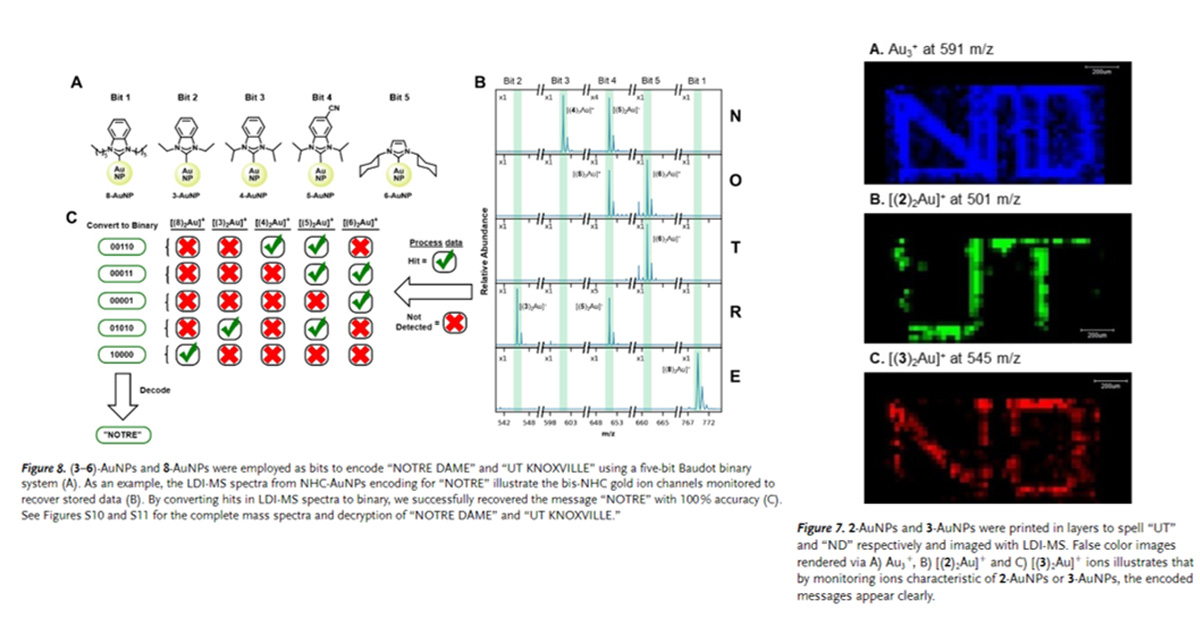
The Jenkins Lab published their research “Giving Gold Wings: Ultrabright and Fragmentation Free Mass Spectrometry Reporters for Barcoding, Bioconjugation Monitoring, and Data Storage” in the international journal Angewandte Chemie. Graduate students Isabel Jensen and Gurkiran Kaur were co-authors on the piece. 

The widespread application of laser desorption/ionization mass spectrometry (LDI-MS) highlights the need for a bright and multiplexable labeling platform. While ligand-capped Au nanoparticles (AuNPs) have emerged as a promising LDI-MS contrast agent, the predominant thiol ligands suffer from low ion yields and extensive fragmentation.

In this work, they developed a N-heterocyclic carbene (NHC) ligand platform that enhances AuNP LDI-MS performance. NHC scaffolds are tuned to generate barcoded AuNPs which, when benchmarked against thiol-AuNPs, are bright mass tags and form unfragmented ions in high yield. To illustrate the transformative potential of NHC ligands, the mass tags were employed in three orthogonal applications: monitoring a bioconjugation reaction, performing multiplexed imaging, and storing and reading encoded information.

These results demonstrate that NHC-nanoparticle systems are an ideal platform for LDI-MS and greatly broaden the scope of nanoparticle contrast agents.

Filed Under: Inorganic Chemistry, News Tagged With: inorganic, Jenkins

chemistry data visualized

Jenkins Group Published in Chemical Science

January 9, 2023 by Jennifer Brown

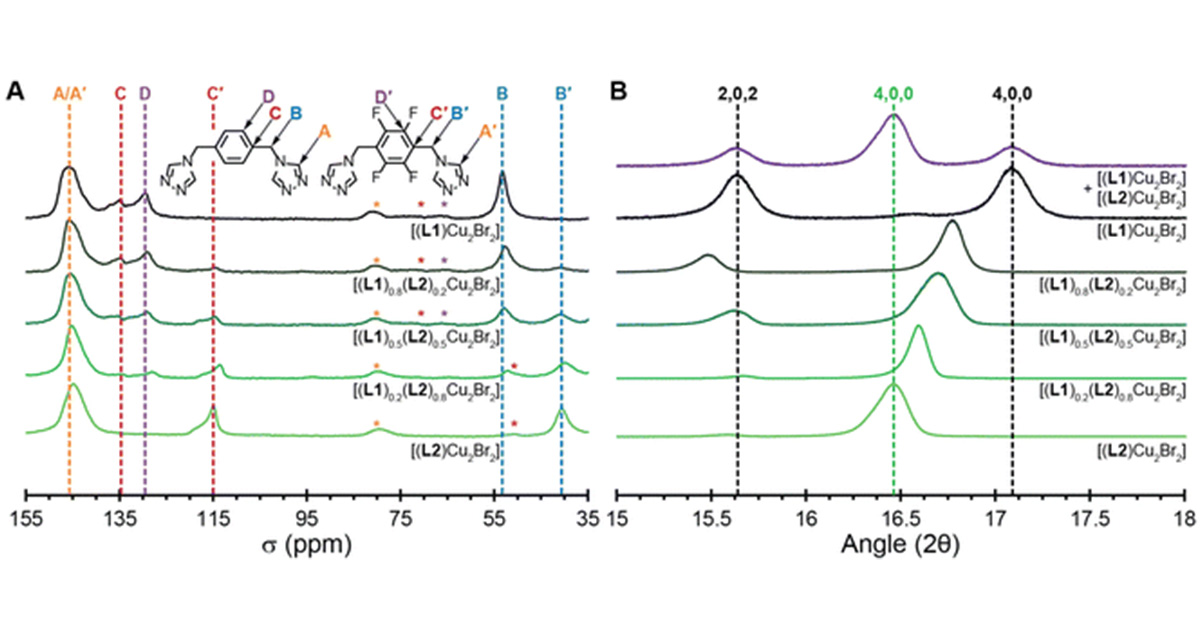
The Jenkins Lab published their research “Statistical copolymer metal organic nanotubes” in the journal Chemical Science. Graduate student Jacob Barrett co-authored the publication.

Metal–organic nanotubes (MONTs) are 1-dimensional crystalline porous materials that are formed from ligands and metals in a manner identical to more typical 3-dimensional metal–organic frameworks (MOFs). MONTs form anisotropically in one dimension making them excellent candidates for linker engineering for control of chemical composition and spacing.

A novel series of MONTs was synthesized utilizing a mixture of 1,2,4-ditriazole ligands containing both a fully protonated aryl moiety and its tetrafluorinated analog in ratios of, 0 : 1, 1 : 4, 1 : 1, 4 : 1, and 1 : 0, respectively. All MONTs were characterized by both bulk and nanoscale measurements, including SCXRD, PXRD, ssNMR and TEM, to determine the resulting co-polymer architecture (alternating, block, or statistical) and the ligand ratios in the solid materials.

All characterization methods point towards statistical copolymerization of the materials in a manner analogous to 3D MOFs, all of which notably could be achieved without destructive analytical methods.

Filed Under: Inorganic Chemistry, News Tagged With: inorganic, Jenkins

Vogiatzis Publishes in Inorganic Chemistry Frontiers

December 6, 2022 by Jennifer Brown

The Vogiatzis group recently published a paper in Inorganic Chemistry Frontiers entitled “Data-driven ligand field exploration of Fe(iv)–oxo sites for C–H activation.”

Methane is the main component in natural gas and is expected to become more and more important to the development of fuels and chemicals for applications such as clean energy, light and heat production, and the development of organic chemicals. However, methane’s instability and flammability make storage and transportation difficult. It is possible to improve methane’s stability by converting it into methanol or light hydrocarbons.

One approach to this is the development of new catalysts that mimic naturally existing enzymes. The Vogiatzis group, led by Associate Professor Konstantinos Vogiatzis, focused their research on non-heme Fe(IV)-oxo model complexes.

“Computational studies provide a fundamental understanding of the electronic effects that control the reactivity of the Fe(IV)-oxo species, but also provide directions for the synthesis of the next generation of catalytic complexes and materials,” said Vogiatzis.

Vogiatzis and his team employed machine learning to more quickly and thoroughly investigate possible complexes that may be most effective. They developed machine learning models that use a novel molecular representation based on persistence homology, called persistence images.

“Our methodology uses a novel molecular fingerprinting method based on persistent homology, an applied branch of topology, that can encode the geometric and electronic structure together with molecular topology,” said Vogiatzis. “The new model is trained on accurate data from a few hundred Fe(IV)-oxo complexes and is capable of providing reliable information for thousands of complexes.”

Vogiatzis believes the insights uncovered in this research will aid in the construction of a theoretical framework for the design of novel catalysts for less energetically demanding industrial processes, including the conversion of methane and natural gas. This publication was co-authored by graduate students Grier Jones, Brett Smith, and Justin Kirkland, members of the Vogiatzis research group.

Filed Under: News, Vogiatzis

Limbach Wins Student Poster Award

November 21, 2022 by Jennifer Brown

Miranda Limbach, third year PhD student, recently earned an Outstanding Student Poster award at the fall meeting of the American Chemical Society (ACS). Limbach’s poster, entitled “Atomic View of Aqueous Cyclosporine A: Unpacking a Decades-Old Mystery,” was one of eight student posters in the division of physical chemistry to be honored at the meeting. 

“This was my first time at the ACS Conference,” said Limbach. “Presenting the poster was lots of fun. Everyone who stopped seemed really interested and the judges were anonymous so you didn’t know who was or wasn’t a judge.”

Limbach’s presentation and poster were based on a collaborative effort between the department, the neutron scattering division at Oak Ridge National Laboratory (ORNL), and the University of Vanderbilt. 

Limbach’s work investigates cyclosporine A, a macrocyclic immunosuppressant. Macrocycles are a class of molecules with the ability to permeate the cell membrane and bind to a number of target proteins. Macrocycles have important applications in the pharmaceutical industry and can contribute to both the development of new drugs, including antibiotics, and the successful delivery of those drugs in the human body.

Earlier in 2022, this work was published in the Journal of the American Chemical Society, with a number of UT Chemistry co-authors, including graduate students Aleksandra Antevska, Damilola Oluwatob, and Amber Gray, Assistant Professor Thanh Do, and Director of Nuclear Magnetic Resonance (NMR) Core Facilities Carlos Steren.

Limbach credits her experience in the Department of Chemistry and time in Thanh Do’s research group with preparing her for a successful presentation.

“The nice thing about Dr. Do’s lab is we use a lot of techniques so we get to learn a little bit of everything,” said Limbach. “I’ve been learning a little bit of mass spectrometry and x-ray diffraction and I learned a lot about 2D NMR. The department has been great. Everyone’s really open to making sure you learn everything you need.”

Limbach plans to continue exploring the significance of cyclosporine analogues during her academic career and, after graduation, is considering a future working with NMR facilities or industry.

Filed Under: Graduate Student Spotlight, News

Sheng Dai Named 2022 Clarivite Highly Cited Researcher

November 15, 2022 by Jennifer Brown

Sheng Dai

Each year, Clarivate identifies the world’s most influential researchers ─ the select few who have been most frequently cited by their peers over the last decade. In 2022, fewer than 7,000, or about 0.1%, of the world’s researchers, in 21 research fields and across multiple fields, have earned this exclusive distinction.

Dai is among this elite group recognized for your exceptional research influence, demonstrated by the production of multiple highly-cited papers that rank in the top 1% by citations for field and year in the Web of Science. Dai was also included in the prestigious ranking in 2021 and 2020, making this his third consecutive year on Clarivite’s Highly Cited Researchers list.

Filed Under: Dai, News Tagged With: Clarivite, Sheng Dia

Sheng Dai Named DOE Distinguished Scientist Fellow

November 4, 2022 by Jennifer Brown

Sheng Dai

Sheng Dai, professor of chemistry and UT-ORNL joint faculty has been named a 2022 Distinguished Scientist Fellow by the Department of Energy (DOE) Office of Science. This competitive award recognizes exceptional scientists with a history of bridging the gap between academic institutions and national laboratories.

Awardees receive $1 million in funding to be spent over three years with the intention of developing, sustaining, and promoting scientific and academic excellence through collaborations between universities and national laboratories. Only two scientists were awarded this year.

Dai was selected for his pioneering work in the development of functional materials for a variety of uses, including separation science, energy storage, catalysis, and other energy-related applications. It was also noted that Dai has a history of engaging in productive collaborations and serving as a mentor for future generations of researchers.

Dai received his PhD from the University of Tennessee, Knoxville and joined the faculty of the chemistry department in 2009. His current research interests include ionic liquids, porous materials, and their applications for separation sciences and energy storage as well as catalysis by nanomaterials. His research has led to the 2020 Max Bredig Award for Ionic Liquids and Molten Salts, the 2019 ACS Award in Separation Science and Technology, and 2018 IMMA Award given by International Mesostructured Materials Association. He is a Fellow of Material Research Society and Fellow of the American Association for the Advancement of Science.

The DOE Office of Science will host a lecture series featuring the 2022 awarded scientists. Dai will discuss his research accomplishments, career trajectory, and experiences November 9 at 1:30pm. The events are open to the public virtually on Zoom. Attendees can register to receive Zoom information.

Filed Under: News Tagged With: Distinguished Scientist Fellow, Sheng Dai

Dai Group Published in Nature Communications

June 16, 2021 by Kayla Benson

The Dai Group published their collaborative research “Formation of three-dimensional bicontinuous structures via molten salt dealloying studied in real-time by in situ synchrotron X-ray nano-tomography” in Nature Communications.

Three-dimensional bicontinuous porous materials formed by dealloying contribute significantly to various applications including catalysis, sensor development and energy storage. This work studies a method of molten salt dealloying via real-time in situ synchrotron three-dimensional X-ray nano-tomography.

Quantification of morphological parameters determined that long-range diffusion is the rate-determining step for the dealloying process. The subsequent coarsening rate was primarily surface diffusion controlled, with Rayleigh instability leading to ligament pinch-off and creating isolated bubbles in ligaments, while bulk diffusion leads to a slight densification. Chemical environments characterized by X-ray absorption near edge structure spectroscopic imaging show that molten salt dealloying prevents surface oxidation of the metal.

“In this work, gaining a fundamental mechanistic understanding of the molten salt dealloying process in forming porous structures provides a nontoxic, tunable dealloying technique and has important implications for molten salt corrosion processes, which is one of the major challenges in molten salt reactors and concentrated solar power plants,” said Phillip Halstenberg, graduate student in the Dai Group.

Filed Under: Artsci, Dai, News Tagged With: chemistry, dai, Nature Communications, ORNL, Research

Vogiatzis Group Published in J. Chem. Phys.

June 16, 2021 by Kayla Benson

Maria White, Graduate student in Vogiatzis GroupThe Vogiatzis Group published their research “Redox states of dinitrogen coordinated to a molybdenum atom” in The Journal of Chemical Physics. Virginia White, graduate student in the Vogiatzis Group, is the first author on this paper that explores the elucidation of ground and excited states of the MoN2 cluster.

Chemical structures bearing a molybdenum atom have been suggested for the catalytic reduction of N2 at ambient conditions. Previous computational studies on gas-phase MoN and MoN2 species have focused only on neutral structures. Here, an ab initio electronic structure study on the redox states of small clusters composed of nitrogen and molybdenum is presented. The complete-active space self-consistent field method and its extension via second-orderperturbative complement have been applied on [MoN]n and [MoN2]n[MoN2]n species (n = 0, 1±, 2±). Three different coordination modes (end-on, side-on, and linear NMoN) have been considered for the triatomic [MoN2]n[MoN2]n.

“Our results demonstrate that the reduced states of such systems lead to a greater degree of N2 activation, which can be the starting point of different reaction channels.” White said.

Filed Under: Artsci, News, Vogiatzis

Xue Group Published in Chem. Eur. J.

June 15, 2021 by Kayla Benson

The Xue Group published their research “Applying Unconventional Spectroscopies to the Single-Molecule Magnets, Co(PPh3)2X2 (X=Cl, Br, I): Unveiling Magnetic Transitions and Spin-Phonon Coupling” in Chemistry—A European Journal. Alex Bone is a graduate student in the Xue and first author of this paper. 

Large separation of magnetic levels and slow relaxation in metal complexes are desirable properties of single-molecule magnets (SMMs). Spin-phonon coupling (interactions of magnetic levels with phonons) is ubiquitous, leading to magnetic relaxation and loss of memory in SMMs and quantum coherence in qubits.

“Direct observation of magnetic transitions and spin-phonon coupling in molecules is challenging,” Bone said. “We have found that far-IR magnetic spectra (FIRMS) of Co(PPh3)2X2 (Co-X; X=Cl, Br, I) reveal rarely observed spin-phonon coupling as avoided crossings between magnetic and u-symmetry phonon transitions.”

Inelastic neutron scattering (INS) gives phonon spectra. Calculations using VASP and phonopy programs gave phonon symmetries and movies. Magnetic transitions among zero-field split (ZFS) levels of the S=3/2 electronic ground state were probed by INS, high-frequency and -field EPR (HFEPR), FIRMS, and frequency-domain FT terahertz EPR (FD-FT THz-EPR), giving magnetic excitation spectra and determining ZFS parameters (D, E) and g values. Ligand-field theory (LFT) was used to analyze earlier electronic absorption spectra and give calculated ZFS parameters matching those from the experiments. DFT calculations also gave spin densities in Co-X, showing that the larger Co(II) spin density in a molecule, the larger its ZFS magnitude.

The current work reveals dynamics of magnetic and phonon excitations in SMMs. Studies of such couplings in the future would help to understand how spin-phonon coupling may lead to magnetic relaxation and develop guidance to control such coupling.

Filed Under: Artsci, News, Xue Tagged With: chemistry, graduate student, publications, Research, Xue

  • « Previous Page
  • 1
  • 2
  • 3
  • 4
  • 5
  • 6
  • …
  • 35
  • Next Page »

Recent Posts

  • Sheng Dai Among World’s Most Highly Cited Researchers for 10 Years
  • Scholar Spotlight: Ziying (Nancy) Lei
  • Hazari Celebrates 35th Anniversary of the Magic of Chemistry
  • Clark Receives NSF Early Career Award
  • Chemistry Building Name Announced

Recent Comments

No comments to show.

College of Arts & Sciences

117 Natalie L. Haslam Music Center
1741 Volunteer Blvd.
Knoxville TN 37996-2600

Phone: 865-974-3241

Archives

  • December 2025
  • October 2025
  • September 2025
  • August 2025
  • July 2025
  • May 2025
  • April 2025
  • March 2025
  • December 2024
  • November 2024
  • October 2024
  • September 2024
  • August 2024
  • July 2024
  • June 2024
  • May 2024
  • April 2024
  • March 2024
  • February 2024
  • December 2023
  • November 2023
  • September 2023
  • July 2023
  • June 2023
  • May 2023
  • April 2023
  • March 2023
  • January 2023
  • December 2022
  • November 2022
  • July 2022
  • June 2022
  • May 2022
  • April 2022
  • March 2022
  • February 2022
  • January 2022
  • December 2021
  • November 2021
  • October 2021
  • July 2021
  • June 2021
  • May 2021
  • April 2021
  • March 2021
  • February 2021
  • January 2021
  • December 2020
  • November 2020
  • October 2020
  • September 2020
  • August 2020
  • July 2020
  • June 2020
  • May 2020
  • April 2020
  • March 2020
  • February 2020
  • January 2020
  • November 2019
  • October 2019
  • September 2019
  • August 2019
  • July 2019
  • May 2019
  • April 2019
  • March 2019
  • February 2019
  • September 2018
  • July 2018
  • June 2018
  • December 2017
  • October 2017
  • September 2017
  • August 2017
  • July 2017
  • June 2017
  • May 2017
  • April 2017
  • March 2017
  • January 2017
  • December 2016
  • November 2016
  • October 2016
  • September 2016
  • August 2016
  • June 2016
  • May 2016
  • April 2016
  • February 2016
  • January 2016
  • December 2015
  • November 2015
  • October 2015
  • August 2015
  • July 2015
  • June 2015
  • May 2015
  • April 2015
  • March 2015
  • February 2015
  • November 2014
  • October 2014
  • September 2014
  • August 2014
  • July 2014
  • June 2014
  • May 2014
  • April 2014
  • March 2014
  • February 2014
  • January 2014
  • December 2013
  • November 2013
  • October 2013
  • September 2013
  • August 2013
  • July 2013
  • June 2013
  • May 2013
  • April 2013
  • March 2013
  • February 2013
  • January 2013
  • September 2012
  • August 2012
  • July 2012
  • June 2012
  • May 2012
  • April 2012
  • February 2012
  • January 2012
  • December 2011
  • October 2011
  • August 2011
  • July 2011
  • June 2011
  • May 2011
  • April 2011
  • March 2011
  • January 2011
  • November 2010
  • October 2010
  • September 2010
  • August 2010
  • July 2010
  • June 2010

Categories

  • ACGS
  • alumni
  • Analytical Chemistry
  • Artsci
  • award
  • Bailey
  • Best
  • BOV
  • Brantley
  • Calhoun
  • Campagna
  • Dadmun
  • Dai
  • Darko
  • Do
  • endowment
  • Faculty
  • faculty
  • Featured
  • fellowship
  • Graduate Student Spotlight
  • Graduate Students
  • Hazari
  • Heberle
  • Inorganic Chemistry
  • Jenkins
  • Kilbey
  • Larese
  • Long
  • Musfeldt
  • NCW
  • Nemykin
  • News
  • newsletter
  • Organic Chemistry
  • outreach
  • Physical Chemistry
  • Polymer Chemistry
  • Sharma
  • Sokolov
  • Uncategorized
  • undergraduate
  • Undergraduate Student Spotlight
  • Vogiatzis
  • Xue
  • Zhao

Copyright © 2026 · University of Tennessee, Knoxville WDS Genesis Child on Genesis Framework · WordPress · Log in

Chemistry

College of Arts & Sciences

552 Buehler Hall
1420 Circle Dr.
Knoxville, TN 37996-1600

Email: chemistry@utk.edu

Phone: 865-974-3141

Facebook Icon  X Icon  Instagram Icon  YouTube Icon LinkedIn Icon

The University of Tennessee, Knoxville
Knoxville, Tennessee 37996
865-974-1000

The flagship campus of the University of Tennessee System and partner in the Tennessee Transfer Pathway.

ADA Privacy Safety Title IX