• Request Info
  • Visit
  • Apply
  • Give
  • Request Info
  • Visit
  • Apply
  • Give

Search

  • A-Z Index
  • Map

Chemistry

  • About
    • Student Organizations
    • Connect With Us
    • Careers With Us
    • Employee/Student Travel Request
  • Undergraduate Students
    • Majors and Minors
    • First Year Students
    • Undergraduate Research
    • Summer Programs
    • Chemistry Lab Excused Absence
    • Apply
  • Graduate Students
    • Prospective Students
    • Admitted Students
    • Current Students
    • Chemistry Graduate Student Handbook
  • Faculty
  • People
  • Research
    • Research Areas
    • Facilities
    • SMLQC 2025
  • News
  • New Chemistry Building
Home » News » Page 5

News

Bailey Published in The Conversation

May 26, 2021 by Kayla Benson

Oil companies are going all-in on petrochemicals – and green chemistry needs help to compete

A Chevron oil refinery in Richmond, California.
AP Photo/Paul Sakuma

Constance B. Bailey, University of Tennessee

Global oil consumption declined by roughly 9% in 2020 as the pandemic reduced business and pleasure travel, factory production and transportation of goods. This abrupt drop accelerated an ongoing shift from fossil fuels to renewable energy.U.S. government forecasts show that oil use for transportation, industry, construction, heating and electricity is declining and will continue to drop in the coming years. This trend has enormous implications for the oil industry: As the International Energy Agency observed in 2020, “No oil and gas company will be unaffected by clean energy transitions.”

Many of these companies are trying to make up losses by boosting production of petrochemicals derived from oil and natural gas. Today roughly 80% of every barrel of oil is used to make gasoline, diesel and jet fuel, with the rest going into petrochemical products. As demand for petroleum fuels gradually declines, the amount of oil used for that “other” share will grow.

This makes sense as a business strategy, but here’s the problem: Researchers are working to develop more sustainable replacements for petrochemical products, including bio-based plastics and specialty chemicals. However, petrochemicals can be manufactured at a fraction of the cost. As a biochemist working to develop environmentally benign versions of valuable chemicals, I’m concerned that without adequate support, pioneering green chemistry research will struggle to compete with fossil-based products.

This video from Austrian oil and gas company OMV shows how petrochemicals serve as building blocks for goods from pharmaceuticals to bike helmets.

Pivoting toward petrochemicals

Petrochemicals are used in millions of products, from plastics, detergents, shampoos and makeup to industrial solvents, lubricants, pharmaceuticals, fertilizer and carpeting. Over the next 20 years, oil company BP projects that this market will grow by 16% to 20%.

Oil companies are ramping up to increase petrochemical production. In the Saudi Arabian town of Yanbu, for example, two state-owned companies, Saudi Aramco and Sabic, are planning a new complex that will produce 9 million metric tons of petrochemicals each year, transforming Arabian light crude oil into lubricants, solvents and other products.

These changes are happening across the global industry. Several Chinese companies are constructing factories that will convert about 40% of their oil into chemicals such as p-Xylene, a building block for industrial chemicals. Exxon-Mobil began expanding research and development on petrochemicals as far back as 2014.

The International Energy Agency projects that petrochemicals will account for one-third of growth in global oil demand through 2030 and half of growth in demand through 2050.

The promise of green chemistry

At the same time, in the U.S. and other industrialized countries, health, environmental and security issues are driving a quest to produce sustainable alternatives for petroleum-based chemicals. Drilling for oil and natural gas, using petrochemicals and burning fossil fuels have widespread environmental and human health impacts. High oil consumption also raises national security concerns.

The Department of Energy has led basic research on bioproducts through its national laboratories and funding for university BioEnergy Research Centers. These labs are developing plant-based, sustainable domestic biofuels and bioproducts, including petrochemical replacements, through a process called “metabolic engineering.”

Researchers like me are using enzymes to transform leafy waste matter from crops and other sources into sugars that can be consumed by microorganisms – typically, bacteria and fungi such as yeast. These microorganisms then transform the sugars into molecules, similar to the way that yeast converts sugar to ethanol, fermenting it into beer.

In the creation of bioproducts, instead of creating ethanol the sugar is transformed into other molecules. We can design these metabolic pathways to create solvents; components in widely used polymers like nylon; perfumes; and many other products.

My laboratory is exploring ways to engineer enzymes – catalysts produced by living cells that cause or speed up biochemical reactions. We want to produce enzymes that can be put into engineered bacteria, in order to make structurally complex natural products.

The overall goal is to put carbon and oxygen together in a predictable fashion, similar to the chemical structures created through petroleum-based chemistry. But the green approach uses natural substances instead of oil or natural gas as building blocks.

This isn’t a new concept. Enzymes in bacteria are used to make an important antibiotic, erythromycin, which was first discovered in 1952.

All of this takes place in a biorefinery – a facility that takes natural inputs like algae, crop waste or specially grown energy crops like switchgrass and converts them into commercially valuable substances, as oil refineries do with petroleum. After fermenting sugars with engineered microorganisms, a biorefinery separates and purifies microbial cells to produce a spectrum of bio-based products, including food additives, animal feed, fragrances, chemicals and plastics.

In response to the global plastic pollution crisis, one research priority is “polymer upcycling.” Using bio-based feedstocks can transform single-use water bottles into materials that are more recyclable than petroleum-based versions because they are easier to heat and remold.

Heaps of debris spill out of shipping containers.

Thousands of pounds of marine debris, much of it plastic, collects on Midway Atoll in the northern Pacific Ocean.
Holly Richards, USFWS

Reducing the cost gap

To replace polluting goods and practices, sustainable alternatives have to be cost-competitive. For example, many plastics currently end up in landfills because they’re cheaper to manufacture than to recycle.

High costs are also slowing progress toward a bioeconomy. Today research, development and manufacturing are more costly for bioproducts than for established petrochemical versions.

Governments can use laws and regulations to drive change. In 2018 the European Union set an ambitious goal of sourcing 30% of all plastics from renewable sources by 2030. In addition to reducing plastic pollution, this step will save energy: Petroleum-based plastics production ranks third in energy consumption worldwide, after energy production and transport.

Promoting bio-based products is compatible with President Biden’s all-of-government approach to climate change. Biomanufacturing investments could also help bring modern manufacturing jobs to rural areas, a goal of Biden’s American Jobs Plan.

But oil company investments in the design of novel chemicals are growing, and the chasm between the cost of petroleum-based products and those produced through emerging green technologies continues to widen. More efficient technologies could eventually flood existing petrochemical markets, further driving down the cost of petrochemicals and making it even harder to compete.

In my view, the growing climate crisis and increasing plastic pollution make it urgent to wean the global economy from petroleum. I believe that finding replacements for petroleum-based chemicals in many products we use daily can help move the world toward that goal.

[You’re smart and curious about the world. So are The Conversation’s authors and editors. You can read us daily by subscribing to our newsletter.]The Conversation

Constance B. Bailey, Assistant Professor of Chemistry, University of Tennessee

This article is republished from The Conversation under a Creative Commons license. Read the original article.
Filed Under: Bailey, News

Honors Day 2021

May 17, 2021 by Kayla Benson

Department of Chemistry recognized the achievements among students, faculty and staff members of the department. Below, you will find a complete list of recipients for the Honors Day 2021.

UNDERGRADUATE AWARDS

ACS-Hach Land Grant Scholarship Allyssa C. Evans, Natalie J. Parsons
CRC Press General Chemistry Award Amy N. Okafor
C.W. Keenan Outstanding General Chemistry Student Award Matthew P. McCoig
Department of Chemistry Scholarships Rowan K. Borsari, Macy M. Hudson
Dr. Lucy E. Scroggie Scholarship Rachel L. Sparks
Halbert and Anne Carmichael Scholarship Isabelle M. Dancer, Ghaeath S. Abbas
C.A. Buehler Chemistry Scholarship Nicholas M. Legaux
Melaven-Rhenium Scholarships Rowan K. Borsari, Macy M. Hudson, Clayton T. West

GRADUATE AWARDS

Keenan Teaching Award Aleksandra Antevska
Outstanding Teaching Award Kevin M. Blatchford, Avery L. Wood
Gleb Mamantov Graduate Chemistry Scholar Jinchao Lou
Jerome Eastham Fellowship in Organic Chemistry Shelby L. Strausser
Eugene John Barber Fellowship in Physical Chemistry Gavin A. McCarver
Judson Hall Robertson Fellowship in Analytical Chemistry Amber L. H. Gray

STUDENT RECOGNITIONS

Goldwater Scholarship Elijah G. Hix
Winners of the Board of Visitor’s Poster Competition Alan D. Fried, Luther J. Langston II
Shull Wollan Center Graduate Research Fellowship Pagnareach Tin
Selected to Attend NX School Alexandria N.  Bone

FACULTY AWARDS

Ziegler Professorship S. Michael Kilbey
2021 Emerging Leader in Molecular Spectroscopy Bhavya Sharma
OpenEye Outstanding Junior Faculty Award Kostas Vogiatzis
Excellence in Research Award Bin Zhao

FACULTY RECOGNITION

New Faculty Viktor Nemykin, Joshua A. Baccile
In Memoriam Fred M. Schell, Albert A. Tuinman

Filed Under: Artsci, News

Jenkins Group Published in Langmuir and Chemical Science

May 12, 2021 by Kayla Benson

The Jenkins Group published their work “Imidazolinium N-Heterocyclic Carbene Ligands for Enhanced Stability on Gold Surfaces” in Langmuir. This work explores the preparation and stability of NHC-coated gold surfaces using imidazolium and imidazolinium NHC ligands. X-ray photoelectron spectroscopy and surface-enhanced Raman spectroscopy demonstrate the attachment of NHC ligands to the gold surface and show enhanced stability of imidazolinium compared to the traditional imidazolium under harsh acidic conditions.

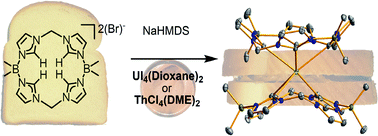
The Jenkins Group also published their work “Actinide tetra-N-heterocyclic carbene ‘sandwiches’” in Chemical Science. “We synthesized new “sandwich” complexes by placing two NHC macrocycles around a single actinide ion,” Jenkins said. “I am particularly excited about this paper since it is work that I began on my sabbatical at the University of Edinburgh almost four years ago.  It is the beginning of a new research area in my group, which is f-block NHC chemistry.” 

Graphical abstract: Actinide tetra-N-heterocyclic carbene ‘sandwiches’The complexes were characterized by a range of experimental methods and DFT calculations. X-ray crystallography confirms the geometry at the metal centre can be set by the size of the macrocyclic ring, leading to either square prismatic or square anti-prismatic shapes; the geometry of the latter is retained in solution, which also undergoes reversible, electrochemical one-electron oxidation or reduction for the uranium variant. DFT calculations reveal a frontier orbital picture that is similar to thorocene and uranocene, in which the NHC ligands show almost exclusively σ-donation to the metal without π-backbonding.

Filed Under: Artsci, Jenkins, News

Musfeldt Group Published in 2D Materials

April 30, 2021 by Kayla Benson

The Musfeldt group published their work “Exploring few and single layer CrPS4 with near-field infrared spectroscopy” in 2D Materials. First author is Sabine Neal, UT chemistry alum.

“We combine synchrotron-based near-field infrared spectroscopy and first principles lattice dynamics calculations to explore the vibrational response of CrPS4 in bulk, few-, and single-layer form,” Neal said. “Analysis of the mode pattern reveals a C2 polar + chiral space group, no symmetry crossover as a function of layer number, and a series of non-monotonic frequency shifts in which modes with significant intralayer character harden on approach to the ultra-thin limit whereas those containing interlayer motion or more complicated displacement patterns soften and show inflection points or steps.”

This is different from MnPS3 where phonons shift as 1/size2 and are sensitive to the three-fold rotation about the metal center that drives the symmetry crossover. “We discuss these differences as well as implications for properties such as electric polarization in terms of presence or absence of the P–P dimer and other aspects of local structure, sheet density, and size of the van der Waals gap,” Neal said.

Figure 1. (a) Crystal structure of CrPS4 at 300 K [23]. The sheet thickness and size of the van der Waals gap are indicated. (b) Schematic of the near-field infrared technique in which an atomic force microscope (AFM) cantilever tip directs light to the sample surface. (c) High resolution AFM image of exfoliated CrPS4. (d) Schematic diagram of the symmetry subgroup relationships as they pertain to the presence or absence of a phosphorus dimer.

Filed Under: Artsci, Musfeldt, News

Musfeldt Group Published in npj 2D Materials and Applications

April 19, 2021 by Kayla Benson

The Musfeldt Group published their work “Chemical bonding and Born charge in 1T-HfS2” in npj 2D Materials and Applications. This is a collaborative research with the Department of Chemical Engineering and Materials Science, University of Minnesota, Minneapolis, MN. 

Their research combines infrared absorption and Raman scattering spectroscopies to explore the properties of the heavy transition metal dichalcogenide 1T-HfS2. They employ the LO–TO splitting of the Eu vibrational mode along with a reevaluation of mode mass, unit cell volume, and dielectric constant to reveal the Born effective charge.

 In addition to resolving the controversy over the nature of chemical bonding in this system, we decompose Born charge into polarizability and local charge. Polar displacement-induced charge transfer from sulfur p to hafnium d is responsible for the enhanced Born charge compared to the nominal 4+ in hafnium. 1T-HfS2 is thus an ionic crystal with strong and dynamic covalent effects. 

This work places the vibrational properties of 1T-HfS2 on a firm foundation and opens the door to understanding the properties of tubes and sheets.

Learn More

Filed Under: Musfeldt, News

Chemistry of Learning: Machines and Humans

April 15, 2021 by Kayla Benson

New courses the Department of Chemistry is offering:

Artificial intelligence (AI) rapidly changes many aspects of chemical sciences, from drug discovery, material design, and the discovery of new reactions and molecules till the acceleration of computer sciences and robotics for chemical applications. In Fall 2021, Dr. Vogiatzis will be teaching Machine Learning for Chemical Applications (CHEM420). This course will cover the key aspects of AI and modern chemoinformatics and how they are applied on chemical sciences.
For more information on this course please email kvogiatz@utk.edu.

In the Spring 2022, students may register for Chemistry of the Brain (CHEM340) with Dr. Sharma. This course will be an overview of basic principles of neuroscience with a focus on the function of key neurochemicals and their receptors. Topics include the chemical bases for neuronal membrane transport, electrical excitability, and ion channels; axonal transport; energy metabolism; synaptic transmission; cellular signaling; Ca2+ homeostasis; neurotransmitters; oxidative stress; apoptosis and necrosis; application of neurochemical principles to the molecular bases of neurodegenerative disorders. Co-Requisite: Organic Chemistry. For more information on this course please email bhavya.sharma@utk.edu.

Filed Under: Artsci, News, Sharma, Vogiatzis

Long Group Published in Chem. Eur. J.

April 15, 2021 by Kayla Benson

The Long Group published their research “Mechanochemical Formation, Solution Rearrangements, and Catalytic Behavior of a Polymorphic Ca/K Allyl Complex” in Chemistry—A European Journal. Authors Brian Long and Alicia Doerr, graduate student, collaborated with Vanderbilt University and the University of Rochester. 

Without solvents present, the often far‐from‐equilibrium environment in a mechanochemically driven synthesis can generate high‐energy, non‐stoichiometric products not observed from the same ratio of reagents used in solution. Ball milling 2 equiv. K[A´] (A´ = [1,3‐(SiMe3)2C3 H3]– ) with CaI2  yields a non‐stoichiometric calciate, K[CaA´3], which initially forms a structure (1) likely containing a mixture of pi‐ and sigma‐bound allyl ligands. Dissolved in arenes, the compound rearranges over the course of several days to a structure (2) with only  η3‐bound allyl ligands, and that can be crystallized as a coordination polymer. If dissolved in alkanes, however, the rearrangement of 1 to 2 occurs within minutes. The structures of 1 and 2 have been modeled with DFT calculations, and 2 initiates the anionic polymerization of methyl methacrylate and isoprene; for the latter, under the mildest conditions yet reported for a heavy Group 2 species (one‐atm pressure and room temperature).

Learn More

Filed Under: Artsci, Long, News, Polymer Chemistry

Albert and Suoma Tuinman’s Passing

April 15, 2021 by Kayla Benson

It is with deep sorrow we announce the death of Albert Andrew Tuinman and Suoma Annikki Tuinman.  The couple passed away in their home on March 16, 2020.  Albert came to the University Of Tennessee Department of Chemistry from the Cancer Research Institute in Tempe, AZ serving in the position of Director of Mass Spectrometry and Research Associate Professor from March 1987 until his retirement in April 2006.  A Celebration of Life ceremony will be held May 29, 2021 at the Norris United Methodist Church, 62 Ridgeway Road, Norris, TN 37828, at 10:45 AM.  The hybrid event will include friends and family throughout Europe and South Africa.  Friends of the Tuinmans are invited to attend either in person or on Zoom. For those interested in attending the event through Zoom, please send Linda Lewis (lewisla7755@gmail.com) your desire to participate.

Filed Under: Artsci, News

Bone Selected to Attend NX School

April 15, 2021 by Kayla Benson

Alex Bone, graduate student in the Xue Group, has been selected to attend the Twenty-Third National School on Neutron and X-ray Scattering to be held virtually from Oak Ridge National Laboratory and Argonne National Laboratory.

Due to the COVID-19 pandemic, the National School on Neutron and X-ray Scattering (NX School) will be held virtually from July 12-30, 2021. The first week of the program will consist of half day lecture sessions, the second and third week will be lectures, remote experiments and data analysis tutorials.

The main purpose of the National School on Neutron and X-ray Scattering is to educate graduate students in the use of major neutron and x-ray facilities. Lectures, presented by researchers from academia, industry, and national laboratories, include basic tutorials on the principles of scattering theory and the characteristics of the sources, as well as seminars on the application of scattering methods to a variety of scientific subjects. Students will conduct short remote experiments at Argonne’s Advanced Photon Source and at Oak Ridge National Laboratory’s Spallation Neutron Source and High Flux Isotope Reactor, which provides hands-on experience using neutron and synchrotron sources.

This year’s NX School will be three weeks in length. The first week will consist of half day lecture sessions. The second two weeks will be full-time consisting of lectures and remote experiments.

Jointly Conducted by: Argonne National Laboratory’s, Advanced Photon Source and Materials Science Division, and Oak Ridge National Laboratory’s Neutron Sciences Directorate and Materials Science and Technology Division.

The School is supported by the U. S. Department of Energy, Office of Science, Basic Energy Sciences, and Materials Sciences and Engineering Division.

Filed Under: Artsci, News, Xue

Tin Awarded Shull Wollan Center Graduate Research Fellowship

April 15, 2021 by Kayla Benson

Pagnareach (Reach) Tin, graduate student in the Xue Group, has been awarded the Shull Wollan Center Graduate Research Fellowship for Spring 2021.

The Shull Wollan Center Graduate Research Fellowship Program has been designed to recognize and support outstanding graduate students in neutron science disciplines who are pursuing research-based doctoral degrees at the University of Tennessee, Knoxville. 

The Shull Wollan Center Graduate Research Fellowship will be awarded to two UTK doctoral students with majors in physics, chemistry, materials science and engineering, biology, or a related area who are engaged in active research as part of their PhD thesis.  Successful applicants will be awarded a monthly stipend for January through June 2021.

Filed Under: Artsci, News, Xue

  • « Previous Page
  • 1
  • …
  • 3
  • 4
  • 5
  • 6
  • 7
  • …
  • 35
  • Next Page »

Recent Posts

  • Sheng Dai Among World’s Most Highly Cited Researchers for 10 Years
  • Scholar Spotlight: Ziying (Nancy) Lei
  • Hazari Celebrates 35th Anniversary of the Magic of Chemistry
  • Clark Receives NSF Early Career Award
  • Chemistry Building Name Announced

Recent Comments

No comments to show.

College of Arts & Sciences

117 Natalie L. Haslam Music Center
1741 Volunteer Blvd.
Knoxville TN 37996-2600

Phone: 865-974-3241

Archives

  • December 2025
  • October 2025
  • September 2025
  • August 2025
  • July 2025
  • May 2025
  • April 2025
  • March 2025
  • December 2024
  • November 2024
  • October 2024
  • September 2024
  • August 2024
  • July 2024
  • June 2024
  • May 2024
  • April 2024
  • March 2024
  • February 2024
  • December 2023
  • November 2023
  • September 2023
  • July 2023
  • June 2023
  • May 2023
  • April 2023
  • March 2023
  • January 2023
  • December 2022
  • November 2022
  • July 2022
  • June 2022
  • May 2022
  • April 2022
  • March 2022
  • February 2022
  • January 2022
  • December 2021
  • November 2021
  • October 2021
  • July 2021
  • June 2021
  • May 2021
  • April 2021
  • March 2021
  • February 2021
  • January 2021
  • December 2020
  • November 2020
  • October 2020
  • September 2020
  • August 2020
  • July 2020
  • June 2020
  • May 2020
  • April 2020
  • March 2020
  • February 2020
  • January 2020
  • November 2019
  • October 2019
  • September 2019
  • August 2019
  • July 2019
  • May 2019
  • April 2019
  • March 2019
  • February 2019
  • September 2018
  • July 2018
  • June 2018
  • December 2017
  • October 2017
  • September 2017
  • August 2017
  • July 2017
  • June 2017
  • May 2017
  • April 2017
  • March 2017
  • January 2017
  • December 2016
  • November 2016
  • October 2016
  • September 2016
  • August 2016
  • June 2016
  • May 2016
  • April 2016
  • February 2016
  • January 2016
  • December 2015
  • November 2015
  • October 2015
  • August 2015
  • July 2015
  • June 2015
  • May 2015
  • April 2015
  • March 2015
  • February 2015
  • November 2014
  • October 2014
  • September 2014
  • August 2014
  • July 2014
  • June 2014
  • May 2014
  • April 2014
  • March 2014
  • February 2014
  • January 2014
  • December 2013
  • November 2013
  • October 2013
  • September 2013
  • August 2013
  • July 2013
  • June 2013
  • May 2013
  • April 2013
  • March 2013
  • February 2013
  • January 2013
  • September 2012
  • August 2012
  • July 2012
  • June 2012
  • May 2012
  • April 2012
  • February 2012
  • January 2012
  • December 2011
  • October 2011
  • August 2011
  • July 2011
  • June 2011
  • May 2011
  • April 2011
  • March 2011
  • January 2011
  • November 2010
  • October 2010
  • September 2010
  • August 2010
  • July 2010
  • June 2010

Categories

  • ACGS
  • alumni
  • Analytical Chemistry
  • Artsci
  • award
  • Bailey
  • Best
  • BOV
  • Brantley
  • Calhoun
  • Campagna
  • Dadmun
  • Dai
  • Darko
  • Do
  • endowment
  • faculty
  • Faculty
  • Featured
  • fellowship
  • Graduate Student Spotlight
  • Graduate Students
  • Hazari
  • Heberle
  • Inorganic Chemistry
  • Jenkins
  • Kilbey
  • Larese
  • Long
  • Musfeldt
  • NCW
  • Nemykin
  • News
  • newsletter
  • Organic Chemistry
  • outreach
  • Physical Chemistry
  • Polymer Chemistry
  • Sharma
  • Sokolov
  • Uncategorized
  • undergraduate
  • Undergraduate Student Spotlight
  • Vogiatzis
  • Xue
  • Zhao

Copyright © 2025 · University of Tennessee, Knoxville WDS Genesis Child on Genesis Framework · WordPress · Log in

Chemistry

College of Arts & Sciences

552 Buehler Hall
1420 Circle Dr.
Knoxville, TN 37996-1600

Email: chemistry@utk.edu

Phone: 865-974-3141

Facebook Icon  X Icon  Instagram Icon  YouTube Icon LinkedIn Icon

The University of Tennessee, Knoxville
Knoxville, Tennessee 37996
865-974-1000

The flagship campus of the University of Tennessee System and partner in the Tennessee Transfer Pathway.

ADA Privacy Safety Title IX